|
JEWISH BERLIN TOURS
GUIDED TOURS ABOUT
JEWISH HISTORY AND JEWISH LIFE
TODAY IN BERLIN (Germany) |
UNTERWEGS offers 22 tours in
German and 8 in English on Jewish
history in Berlin. |
Today Berlin is the
fastest growing Jewish community in the
world and it has the widest
range of Jewish
activities in Germany.
FROM THE BEGINNINGS TO PRESENT-DAY
JEWISH LIFE
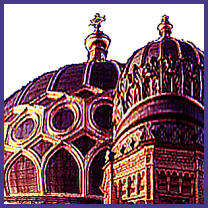
Around the New Synagogue in
Oranienburger Street we find different Jewish institutions from the past
such as the first cemetery, an old-age people’s home which became a
deportation center, the Jewish boys’ school, an orphanage, a hospital, an
orthodox rabbinical seminary, the liberal academy for Judaism, all of
which represent the variety of Jewish life before the Nazi Period. New
beginnings such as a Jewish community center , a Jewish high school,
egalitarian groups and plans by the orthodox community Adass Jisroel for a
new synagogue show present Jewish life.
EAST EUROPEAN IMMIGRANTS ON THEIR
WAY TO AMERICA
From 1885 - 1925 many Jews from
Eastern Europe flew from pogroms, discrimination and hunger to Berlin in
search of a better life. Most of them wanted to emigrate to the US. (Many
failed because of the quota introduced in the twenties.) Most of them
started a new life in the Barn Quarter, where the poor lived. There, they
had their own institutions (stiblech, mikva, political groups ...) and
maintained a lifestyle which was rooted in their orthodox background and
different from that of assimilated Jews who lived in the west of Berlin.
JEWISH LIFE IN SCHOENEBERG
At the turn of the century many upper
middle-class Jews moved to Schoeneberg which was called "Jewish
Switzerland": Scientists (Einstein), artists (Billy Wilder, Elia Kazan,
the Comedian Harmonists), poets and journalists (Gertrud Kolmar, Else
Lasker-Schüler, Kurt Tucholsky, Alfred Kerr) and Rabbis (Naphtali
Carlebach, Alexander Altmann, Leo Baeck, Naphtali Herz Tur-Sinai). Some
years ago a memorial was set up, which consists of 80 plaques: the front
shows a symbol (bread, musical instrument) and on the back is printed one
of the Nazi laws. The plaques depict the discrimination and persecution of
the Jewish population.
JEWISH LIFE IN CHARLOTTENBURG
From 1895 to 1910 the Jewish
population of Charlottenburg increased from 4600 to 22,500. New
institutions were set up (synagogues, schools, mikvah, social services).
The Kurfuerstendamm with its famous cafés became the center of the
avant-garde (writers, painters, musicians, critics...). After the Shoah
many displaced persons came from Eastern Europe and started a Jewish life
which was intended to be temporary. In 1959 the Jewish community center
was inaugurated in West Berlin and so Charlottenburg became the center of
the post war Jewish community in West Berlin. Today Berlin is - because of
the Russian Jewish Immigration - the fastest growing Jewish community of
the world.
WOMEN’S
HISTORY
- JEWISH WOMEN BETWEEN PERSECUTION AND
RESISTANCE
- JEWISH WOMEN AROUND THE FIRST
WOMEN`S MOVEMENT
- JEWISH SOCIAL WORK AND HEALTH
SERVICES
- REGINA JONAS - THE FIRST WOMAN RABBI
OF THE WORLD
OTHER TOPICS
- Sephardic Jews in Berlin
- Changing Concepts of Jewish Teaching
and Learning: Beth haMidrasch, Torah-Talmud-Classes, Rabbinic Seminary,
Schools, Adult Education, Liberal Academy for Judaism and important
teachers such as Moses Mendelssohn, Esriel Hildesheimer, Abraham Geiger,
Leo Baeck
- How Jews lived behind the Iron
Curtain: The Jewish Community in the East of Berlin
 [UNTERWEGS]
 |